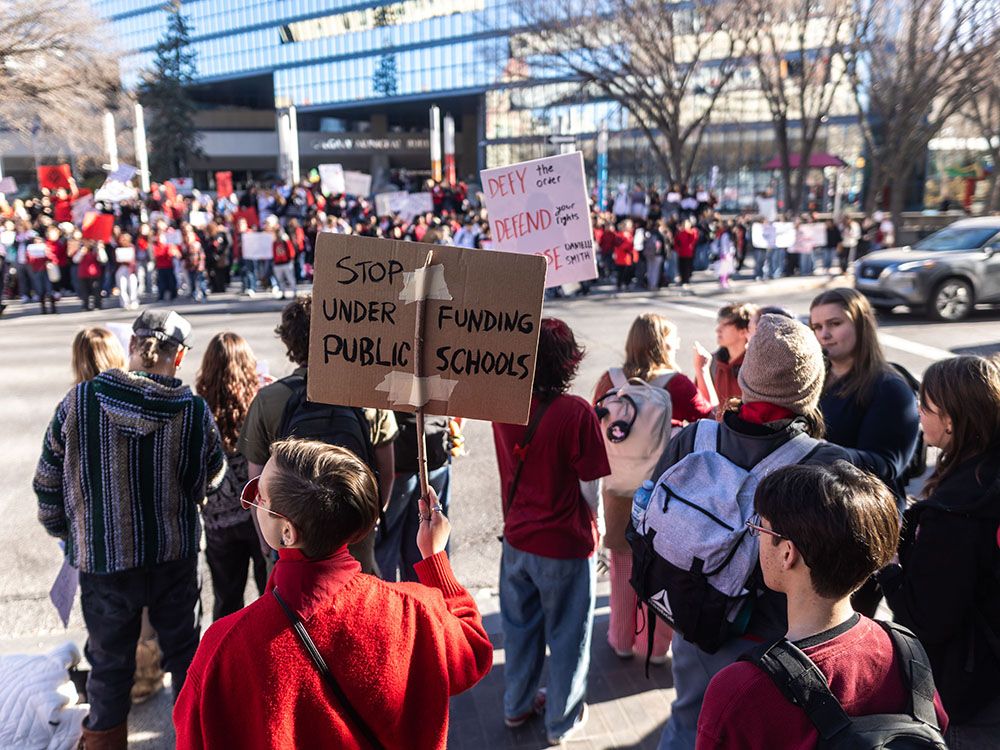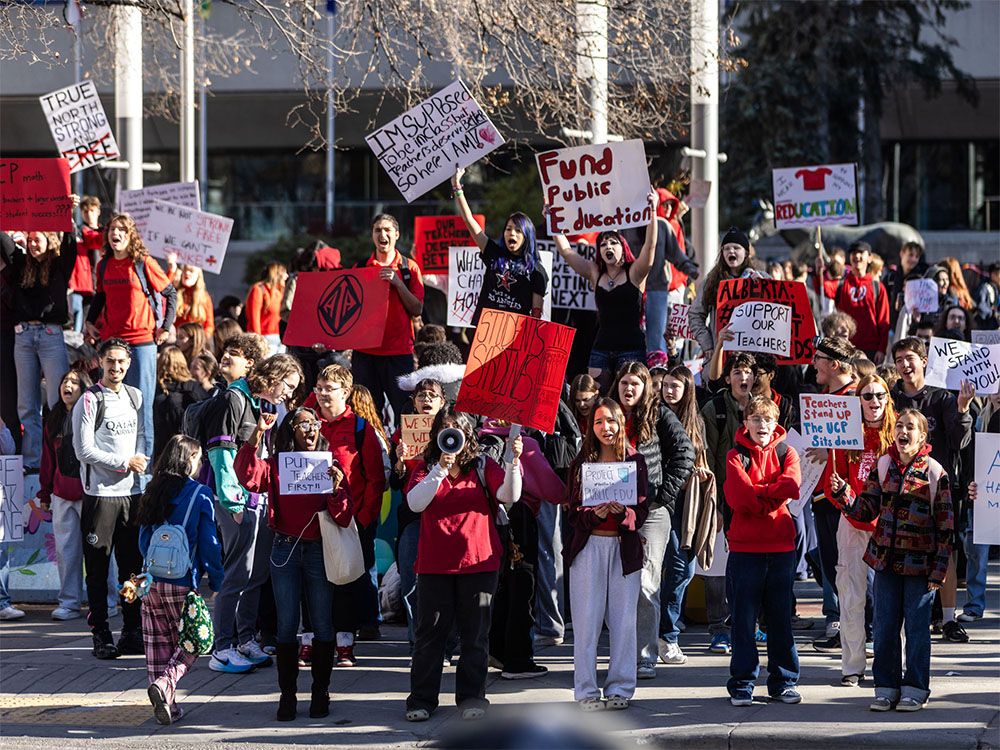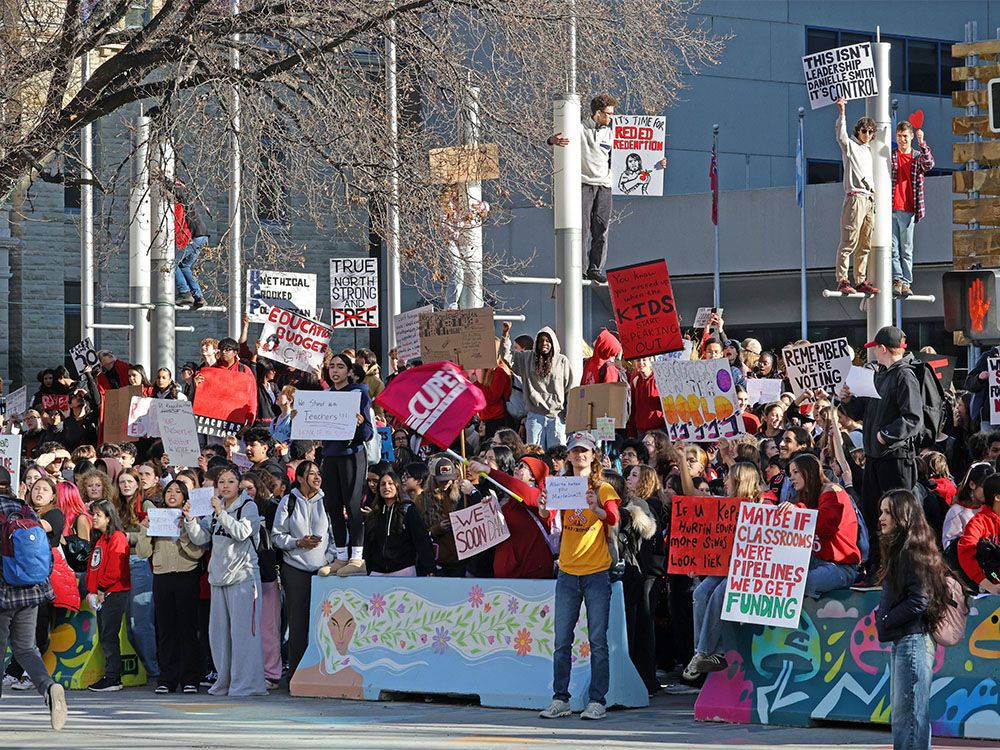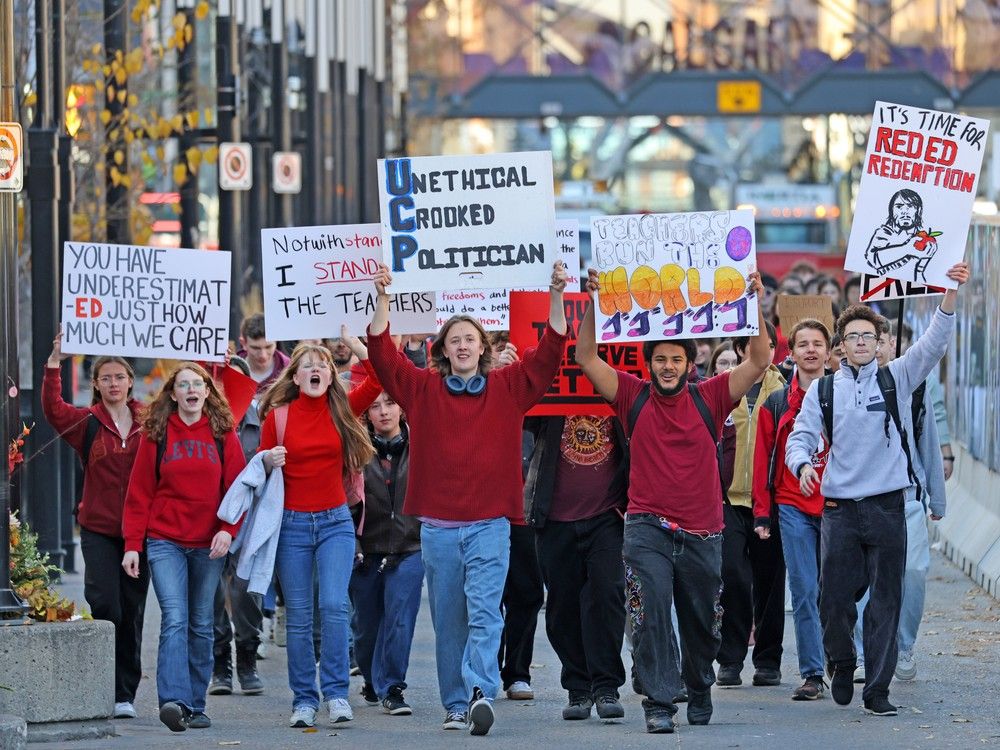
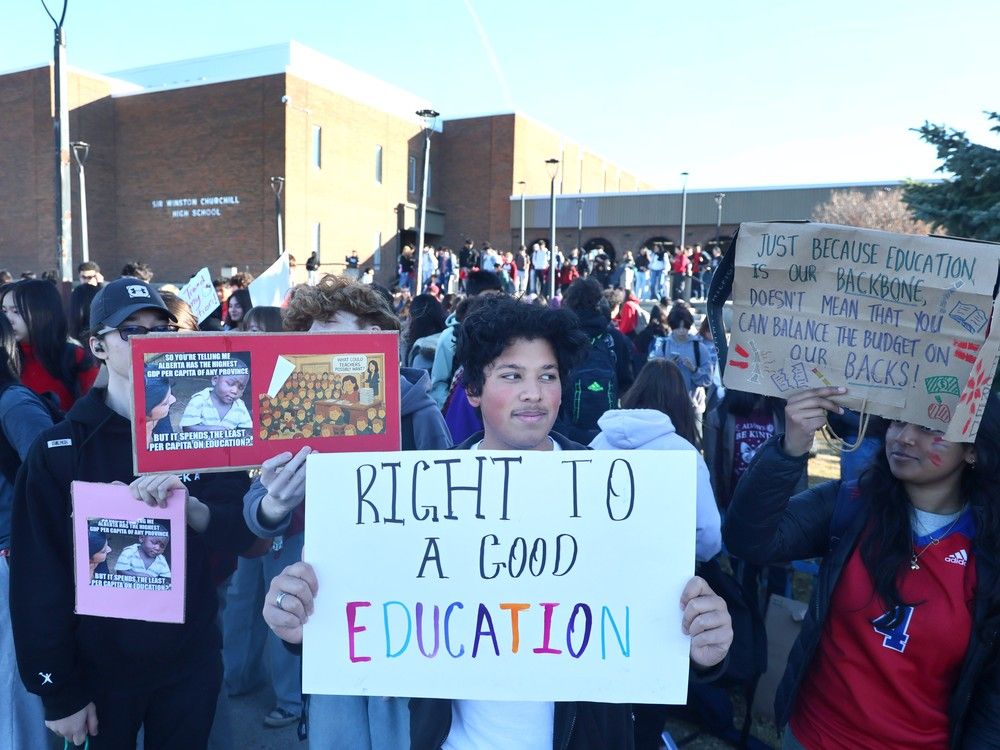
At 11 a.m. on a crisp Thursday, students flooded out of their schools across Calgary, backpacks slung over their shoulders, many wearing hoodies and red t-shirts while holding up posters made from cardboard and paper.
Joshua Brawn’s poster read “No Education Without Educators.”
“Without our educators, our future is gone,” said the Grade 12 student, standing on the pavement outside Sir Winston Churchill High School. “There’s nothing that we can build towards for the future of everybody.”
More than 100 students crowded on the sidewalk outside their school, waving their posters and chanting slogans in support of their teachers. Several times, a passing car would honk in support, eliciting cheers and yells from the student crowds.
“This was actually bigger than I expected,” said Vaishnavi Venkateshwaran, one of the coordinators for the walkout. “People were really on the fence in the past two days. I think people realized that these are our teachers, these are people we have to stand up for and the precedent that’s been set in this bill is something we shouldn’t take lying down.”
Her school is among the 73 schools across the province protesting the legislation via coordinated walkouts on Thursday.
“We made sure to plan it on the same day and kind of around the same time. We really wanted to make a statement. And we thought that if all of these schools, and over 30 schools kind of walked out on the same day. It was really, like, grabbed people’s attention,” said Mady Lagman, a student organizer with Father Lacombe Senior High School.
‘It impacts everybody, not just teachers’
All of Venkateshwaran’s peers who spoke with Postmedia agreed with her sentiments. “It’s unconstitutional what Danielle Smith did,” said Taylor Latter, a Grade 10 student.
A few minutes earlier in the crowd, an unidentified student yelled, “F— Danielle Smith!”
Latter’s poster read, “Thank a teacher. Pay them fairly.”
“It speaks for itself,” she said. “Teachers should be paid fairly for everything they do.”
The strike and the student walkout particularly hit home for Zoe Gordon, a Grade 12 student, whose parents work as teachers at other schools.
“It was really stressful at home,” she said, adding that her parents were worried about not being able to be at school for their students.
“And just coming back to school has been a real challenge as a lot of their rights have been taken away,” she added.
“They’re in full support of it,” she said, of her parents on the student walkout. “They love the idea of me going and being out here.”
The walkout, she emphasized, wasn’t just about fighting for teachers and their salaries. “It’s about complex needs in classrooms and not being able to support them. It’s important to understand that this also affects us. And then, by taking away so much of our teachers’ rights and the right to education and trying to privatize schools, it impacts everybody, not just teachers.”
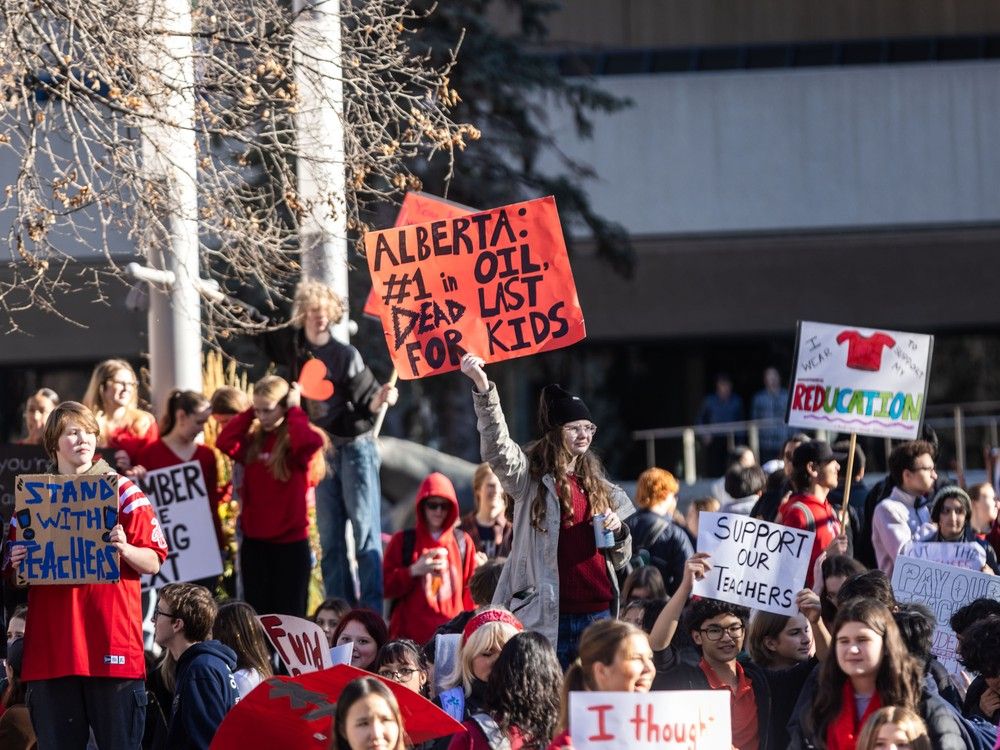
Classroom sizes major issue for students
During the three weeks that schools were closed, Emily Zhang, a Grade 12 student pursuing her International Baccalaureate Diploma at Sir Winston Churchill High School, said she held tutoring sessions of up to 18 students.
Even within her own class sizes, she wasn’t sure just how much of the material her students learned. “I don’t know if these students actually understand what’s being taught,” she said.
She related her experience to that of an Alberta teacher teaching a classroom of 40 or more students. “I don’t want to continue sitting in a classroom of 64 students,” she said. “I don’t want to see my friends fail because the government cannot properly fund our education.”
Venkateshwaran said the classroom size numbers make it difficult for teachers to pay attention to the needs of each student. “It’s much harder to spare their time,” she said. “Even if they have tutorial, it’s still not enough time for all of them to meet each of the students and meet their needs for all of their education.”
Brawn echoed the same. “In reality, (our classroom sizes) should be around 25,” he said. “It limits the education you’re able to get. You’re not allowed to have as much one-on-one time with the teachers.”
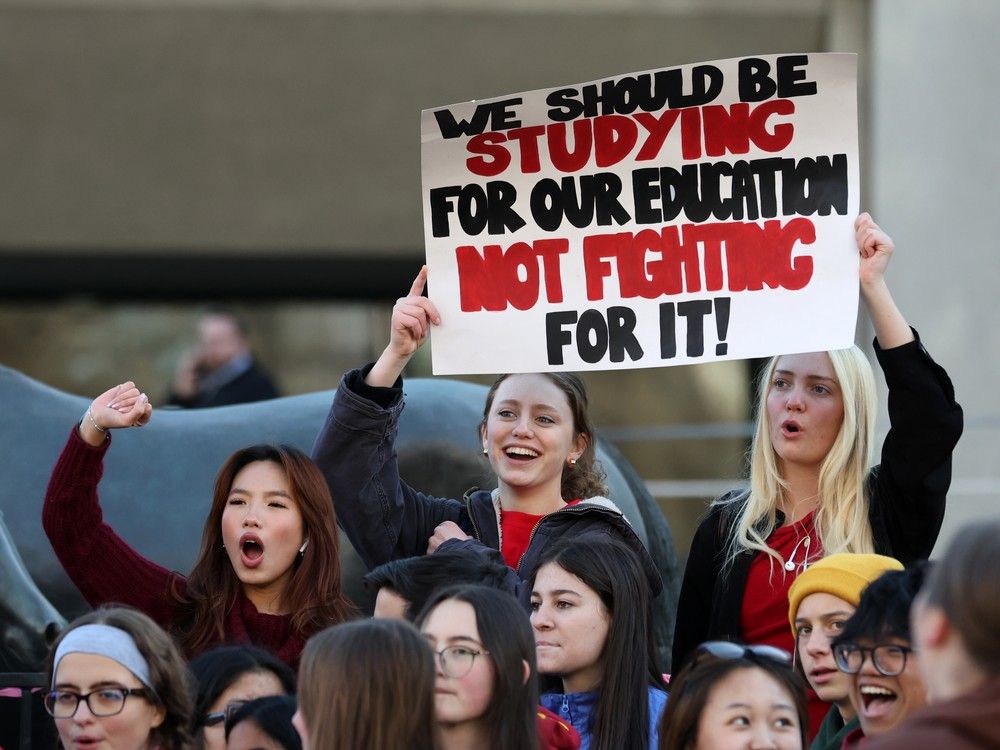
At William Aberhart High School, hundreds of students walked out to protest against the legislation, including inaction on classroom sizes, according to Arya Mishra, a Grade 12 student and organizer with the student group Alberta Students For Teachers.
“We all have the same vision. We want those classroom cap sizes. We want more funding to public education rather than private education. We all agreed and symbolically felt unseen for quite some time. Long before the strike, we had large classroom sizes,” she said.
“We are different from university students in the sense that we are not equipped for those large classes,” she said.
Concerns about January diplomas
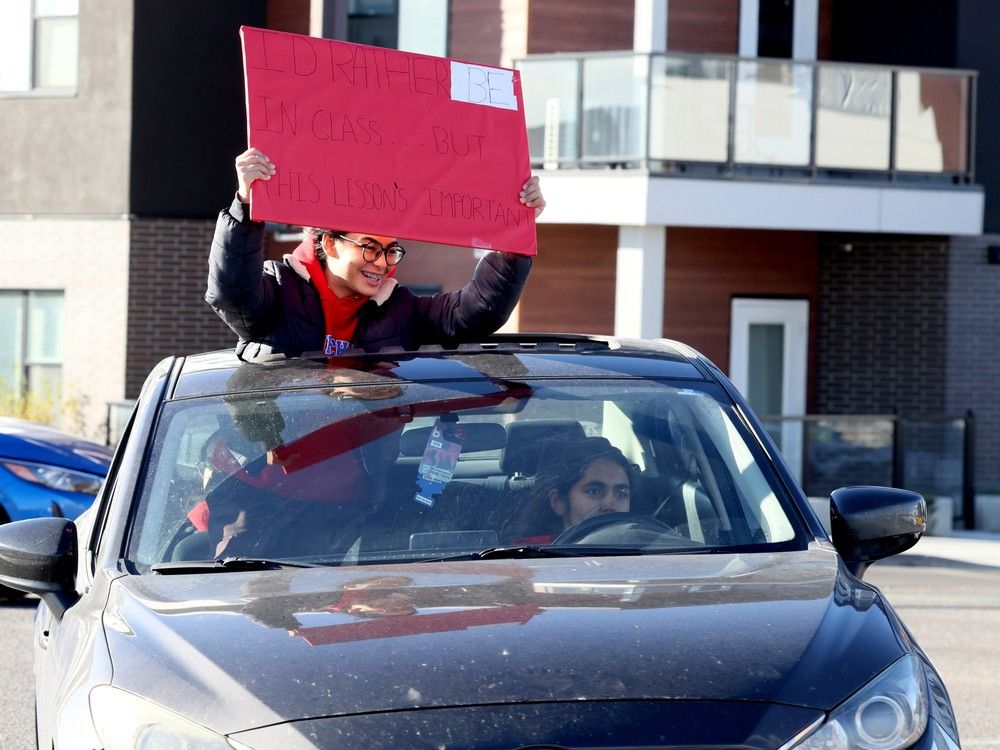
Many of the students protesting the walkout on Thursday are in their senior year and voiced concerns about being able to complete courses in time to take their diplomas in January.
Missing out on three weeks of school was “harsh,” Venkateshwaran said, adding that the main conversation since returning to school has been worrying about how to catch up.
“Especially in an IB classroom, you’re going over university-level content and you’re paying $200 for every exam you take and you’re using that for university credits . . . it matters significantly to my future,” she said.
Zhang said she tried teaching herself high-level economics and physics to catch up on her courses. “In my economics class, how we learn is through organic instruction,” she said, based on their teacher’s own knowledge. “You cannot simply open a textbook, read an article and boom, you understand economics.”
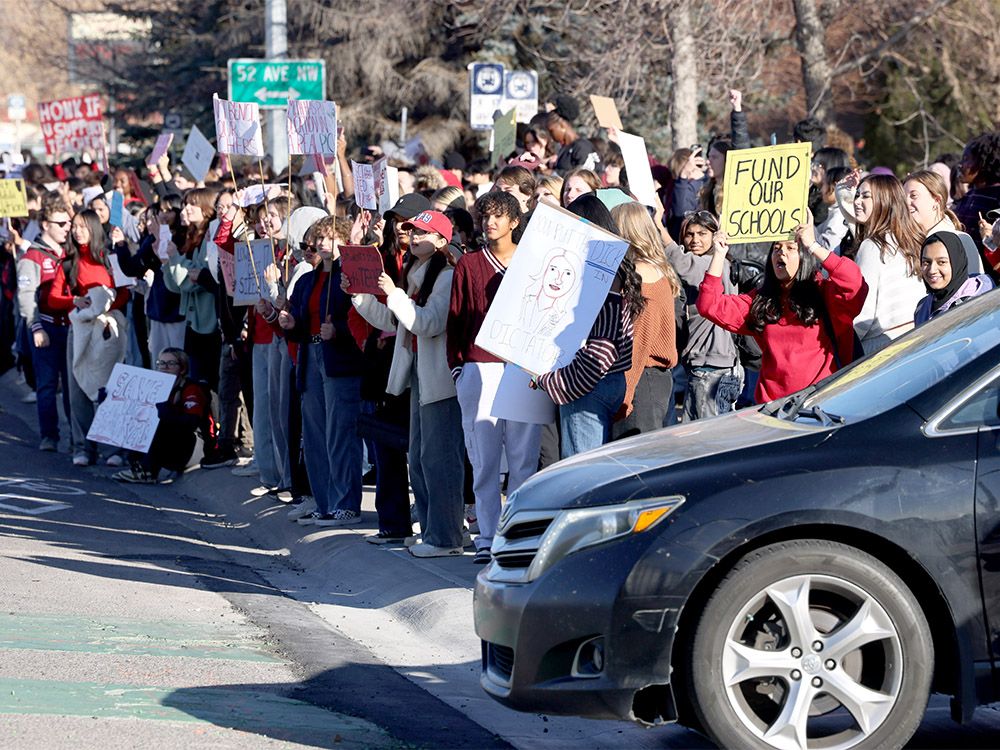
Throughout the walkouts and the weeks before, students have repeatedly asked for three things, according to Mishra — classroom cap sizes, better funding and more student resources.
“And the only new one that I’ve seen occur is that we want our diplomas in January to be optional. So that is a total of four demands,” she said. “It’s really simple, and we hope that the government can understand that there are quick ways to fix our struggles.”
Seeing students come out to support the walkouts and their teachers’ rights was “exhilarating,” she said.
“We knew that the teachers were doing that for a good purpose and we wanted to keep fighting,” she said. “Because truly, caregivers, teachers and students, we’re all on the same side.”